
NIGERIA TO HOST FIRST EVER GLOBAL AMR CONFERENCE ON AFRICA SOIL, HARPS ON PREVENTION THROUGH MULTISECTORAL APPROACH.
Nigeria is set to make history as it hosts the 5th Global High-Level Ministerial Conference on Antimicrobial Resistance (AMR) in Abuja, the first time the global gathering will be held on African soil.
The conference, themed “One Health — Advancing Global AMR Commitments through Local Action,” is scheduled for December 6-8, 2026 at the Transcorp Hilton, Abuja, and will bring together ministers and global health, agriculture and environmental stakeholders from over 100 countries to review progress and develop practical solutions to combat AMR, a crisis linked to an estimated 1.3 million deaths annually worldwide.
Speaking at the Press briefing held at the Conference Room of the Federal Ministry of Agriculture and Food Security today, 12th October 2026, the Coordinating Minister of Health and Social Welfare, Prof. Muhammad Ali Pate,
Described AMR as a “silent pandemic” and a complicated problem that kills quietly, said the threat requires a combined attack across human health, animal health, agriculture and the environment.
Pate noted that when antibiotics and other antimicrobials stop working, routine infections become dangerous, surgery and childbirth carry greater risk, and the cost of care rises for every family.
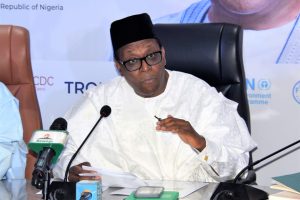
He said Nigeria is proud to host the 5th edition to deliver on global promises already made — the 2024 UN Political Declaration on AMR, the Muscat Manifesto and the Jeddah Commitments — with the Abuja conference billed to adopt the Abuja Compact on AMR.
The Coordinating Minister of Health and Social Welfare added that Nigeria’s approach goes beyond healthcare, adopting a One Health strategy that brings together health, agriculture, livestock and environment, warning against indiscriminate and wrong use of antibiotics and urging Nigerians to avoid self-medication and complete their doctor’s prescription to the end.
Also speaking, the Minister of Environment, Malam Balarabe Abbas Lawal, stressed that resistance does not respect boundaries between sectors as it moves from people to animals, from farms to food, and through water, soil and waste, hence no single ministry can win the fight alone.

He said the four ministries — Health and Social Welfare, Agriculture and Food Security, Livestock Development, and Environment — are committing to:
1. Act as one government, through a joint One Health coordination mechanism that will outlast the conference;
2. Deliver local action in every sector: responsible antimicrobial use in hospitals, on farms and in animal production, and safe management of waste and water;
3. Host an inclusive conference that gives voice to governments, scientists, civil society, youth, the private sector and communities; and
4. Be accountable, by reporting publicly on Nigeria’s progress and supporting follow-up of the Abuja Compact through the Troika mechanism.
Lawal stressed that a clean environment, improved sanitation, personal and community hygiene are critical to preventing infections that drive the need for antibiotics.
On his part, the Minister of Livestock Development, Idi Mukhtar Maiha, represented by the Chief Veterinary Officer, Dr. Abdukareem Durosunlorun,stressed the need for farmer education, warning farmers not to prioritise profit over human health. He urged poultry and livestock farmers to use antibiotics only on prescription and to strictly observe withdrawal periods before taking their products to the market.
In his welcome remarks, the Minister of State for Agriculture and Food Security, Sen. Dr. Aliyu Sabi Abdullahi, represented by the Director, Plant Health and Pest Control Services, Mrs Iwendi Grace Odunola, said AMR is not only a human health challenge but a significant threat to agriculture and food security. He noted that while antimicrobials are used to protect human, animal and plant health, their inappropriate or excessive use accelerates resistance, undermines disease control, reduces agricultural productivity, compromises food safety, disrupts trade and threatens farmers’ livelihoods.
According to him, the theme underscores the urgent need to translate global commitments into practical, measurable actions that protect people, agriculture, food systems and the environment, adding that the collective voice of the four ministries is critical because resistance can emerge and spread across people, animals, food systems and the environment.
From the agricultural perspective, he said the Ministry’s priorities include promoting responsible use of antimicrobials and agrochemicals, strengthening food safety systems, expanding agricultural extension services and educating farmers on good agricultural practices, biosecurity and Integrated Pest Management, with sustainable alternatives that protect crops, livestock, consumers and the environment.
The meeting, to be co-led by the four ministries and hosted by President Bola Ahmed Tinubu, will feature Non-State Actors Day, ministerial sessions on delivery, high-impact interventions and governance, and a closed-door ministerial roundtable culminating in the adoption of the Abuja Compact and handover of the Presidency to Brazil as host of the 6th meeting in 2028.
Ezeaja Ikemefuna
Head, Department of Information
12/10/2026