WORLD FOOD DAY: FG RESTATES COMMITMENT TO FOOD SECURITY FOR ALL NIGERIANS AS AGRIC SECTOR RECORDS 4.39% GROWTH
The Federal Government has restated its commitment to ensuring food security for all Nigerians as the agricultural sector records 4.39% overall growth.
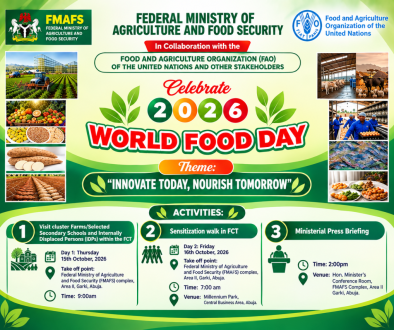
In a statement to commemorate the 2026 World Food Day themed “Innovate Today. Nourish Tomorrow,” the Honourable Minister of State for Agriculture and Food Security, Sen. Dr. Aliyu Sabi Abdullahi, CON, said the theme captures the fundamental reality that tomorrow’s food security will be determined by today’s innovations.
The Minister noted that the Ministry, under their strategic leadership, is implementing a comprehensive approach to transform Nigeria’s agricultural sector into a productive, resilient, competitive and investment-driven sector capable of feeding the population and contributing substantially to economic growth.
He added that the approach is anchored on ensuring Nigeria produces more food, reduces food losses, strengthens agricultural value chains and enables farmers to produce profitably, through interventions across the entire value chain from research and inputs to storage, processing, financing, marketing and consumption, in collaboration with State Governments, farmers’ organizations, development partners, research institutions, financial institutions and the private sector.


Citing data from the National Bureau of Statistics (NBS), the Minister disclosed that agriculture is back on a strong growth trajectory for the first time since 2021, with the sector recording 4.39% overall growth in the second quarter of 2026 and crop production expanding by 3.66%.
He described the growth as evidence that reforms and investments under the Renewed Hope Agenda of President Bola Ahmed Tinubu, GCFR, are yielding impact.
Providing further evidence of progress, the Minister announced that Nigeria’s annual domestic wheat production has risen to approximately 420,000 metric tonnes, representing a 3.5-fold increase from the previous baseline of 120,000 metric tonnes, driven by the National Agricultural Growth Scheme and Agro-Pocket (NAGS-AP).
He stated further that through NAGS-AP, in just four farming seasons, the Ministry has supported smallholder farmers to produce 2.5 million metric tonnes of staple foods.
Sen. Abdullahi highlighted that the Ministry has moved from rhetoric to action on mechanization with the commissioning of the Renewed Hope Agricultural Mechanization Programme with 2,000 tractors and implements, to make farming more efficient, less labour-intensive and attractive to youth.
He listed other interventions to include commencement of soil mapping under the National Soil Health and Fertility Programme, promotion of bio-fortified crops, revitalization of extension services with newly trained frontline agents and digital e-extension platforms linked to the National Farmers Registry harmonized with NIN.


The Minister said that Government is decisively tackling high prices at the source through aggressive dry-season farming, investments in Special Agro-Industrial Processing Zones (SAPZs), storage and cold-chain facilities to cut post-harvest losses from 40% to under 20%, combined with orderly release from the Strategic Food Reserve and a Guaranteed Minimum Price.
He noted that Government is promoting climate-smart agriculture, expanding irrigation, repositioning the Bank of Agriculture for affordable financing, and strengthening agricultural insurance and pest surveillance.
He further revealed that the implementation of the National Cooperative Identity Reform under the Renewed Hope Cooperative Reform and Revamp Programme (RH-CRRP 2030) would transform Nigeria’s cooperative ecosystem into a credible, transparent and bankable economic bloc.
He explained that the RH-CRRP 2030, unanimously approved by the 8th National Council on Cooperative Affairs in March 2026, provides a seven-pillar reform framework covering legal and regulatory reform, digitalization and data management, cooperative finance, capacity building, enterprise growth, socio-economic inclusion and strategic partnerships.
While acknowledging insecurity in some major food-producing belts in Northern Nigeria, he said Government is addressing it through deployment of agro-rangers to protect farmlands and enhanced collaboration between security agencies and farming communities.
Sen. Abdullahi stressed that food security is a collective responsibility and appreciated the Food and Agriculture Organization (FAO) and other partners for their support.
He reaffirmed the Ministry’s resolve to build a sector capable of feeding the nation and driving economic growth.
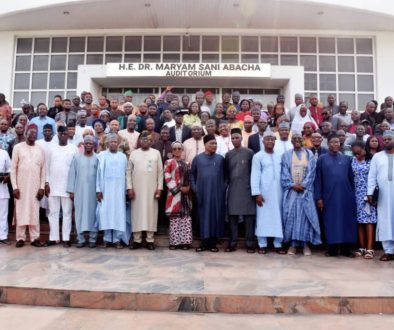
Speaking during the Walk and Sensitization Rally to Mark the Event, the Permanent Secretary in the Ministry, Dr. Marcus Olaniyi Ogunbiyi stated: “the significance of World Food Day lies in its call for action. It challenges us to look beyond the food on our tables and consider the farmers who produce it, the resources required to grow it, the systems that preserve and distribute it, and the millions of people who still struggle to afford a healthy meal.
Dr. Ogunbiyi added that ‘’It is also an opportunity to celebrate the contribution of farmers and other actors across the food value chain, recognise progress made, confront existing challenges and renew our determination to end hunger’’.
He pointed out that ‘’it is against this background that this year’s theme, Innovate Today. Nourish Tomorrow, assumes particular importance. It reminds us that the future of food security depends on the decisions and investments we make today. Innovation must extend beyond modern machinery and digital technology to include improved seeds, better farming practices, efficient irrigation, sustainable soil management, effective storage, food processing, improved transportation and the reduction of post-harvest losses. It must also involve practical solutions that enable smallholder farmers, women and young people to participate meaningfully in agricultural development’’.
In his remarks, the country representative for Nigeria and ECOWAS, Food and Agriculture Organization of the United Nations, Dr. Hussein Gadain, represented by the FAO Programme Officer, Jimmy Owani stated that the central message of World Food Day 2026 is that innovation delivers its greatest impact when it reaches the people who need it most, the benefits of innovation must not remain confined to laboratories, research institutions or policy discussions. They must reach farmers’ fields, fishing communities, pastoral systems, rural enterprises and households across Nigeria’’.
Dr. Gadain Further said that ‘’ by investing in people, fostering innovation and strengthening partnerships, we can build resilient agrifood systems, end hunger, improve nutrition and ensure that no Nigerian is left behind’’.
During his Goodwill Message, the national president Coalition of Farmers Associations for Food Security in Nigeria (COA-FARMERS), Chief Emmanuel Anoh lauded the agricultural transformation, which is geared toward achieving food and nutrition security, boosting economic growth, and improving the livelihoods of Nigerian farmers
Ezeaja Ikemefuna
Head, Department of Information