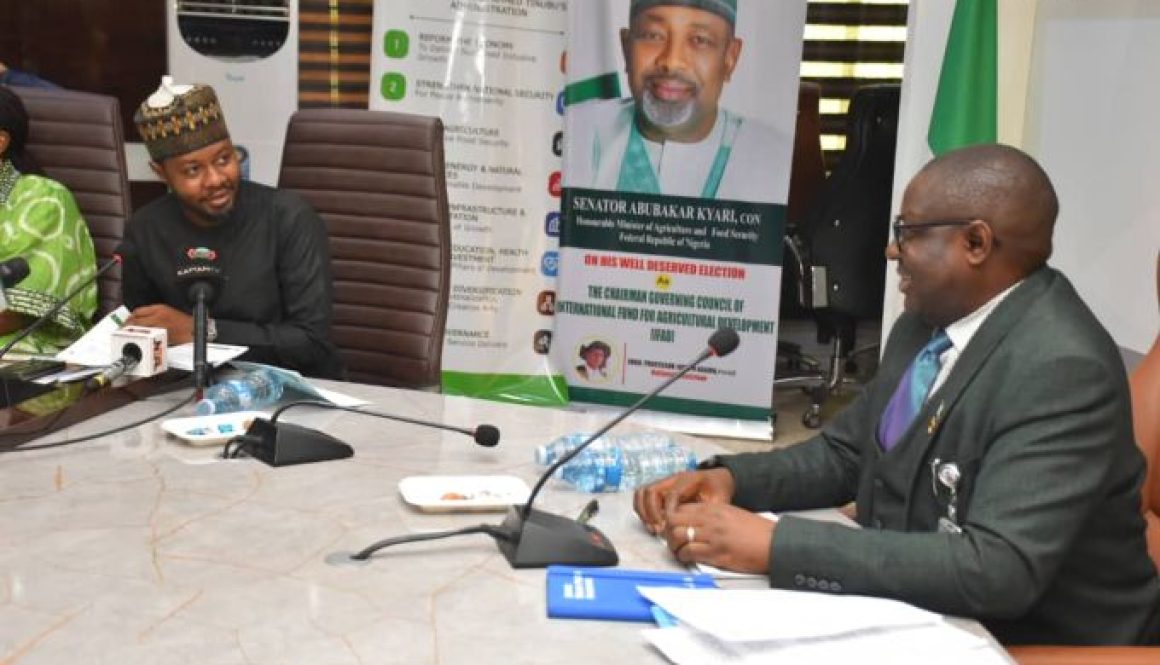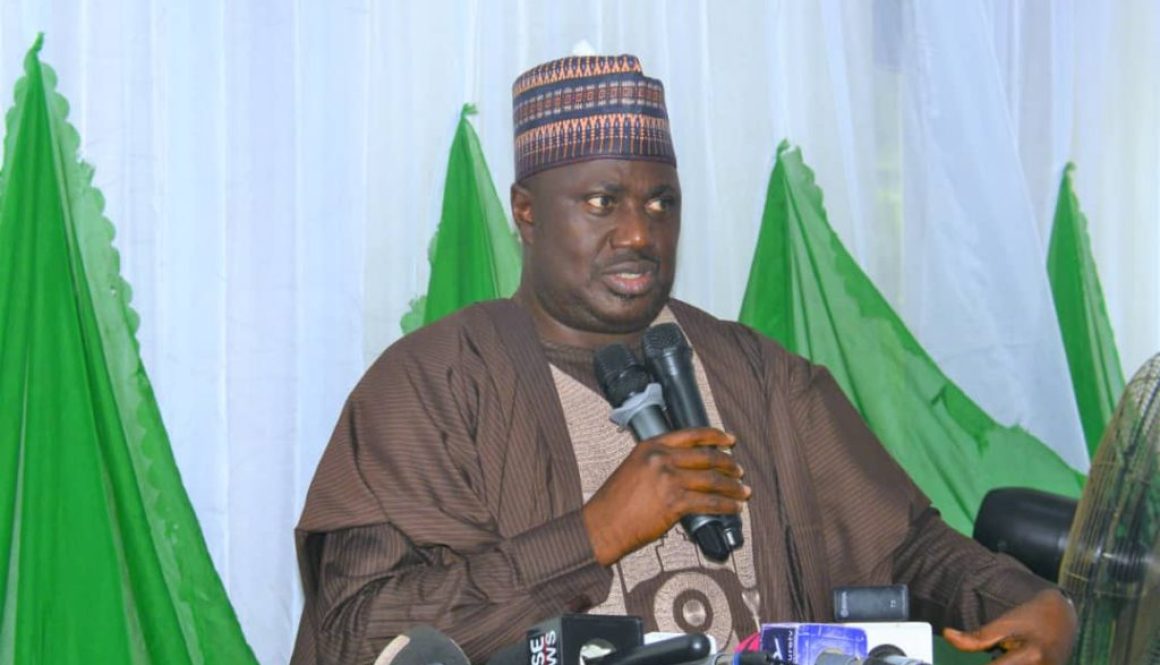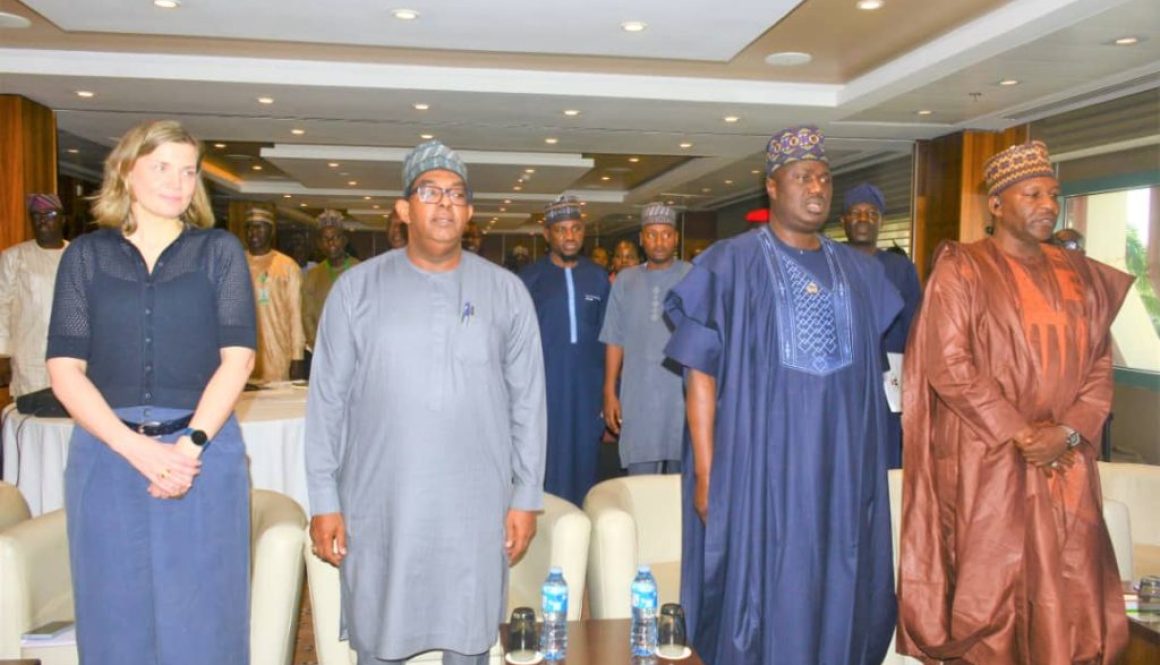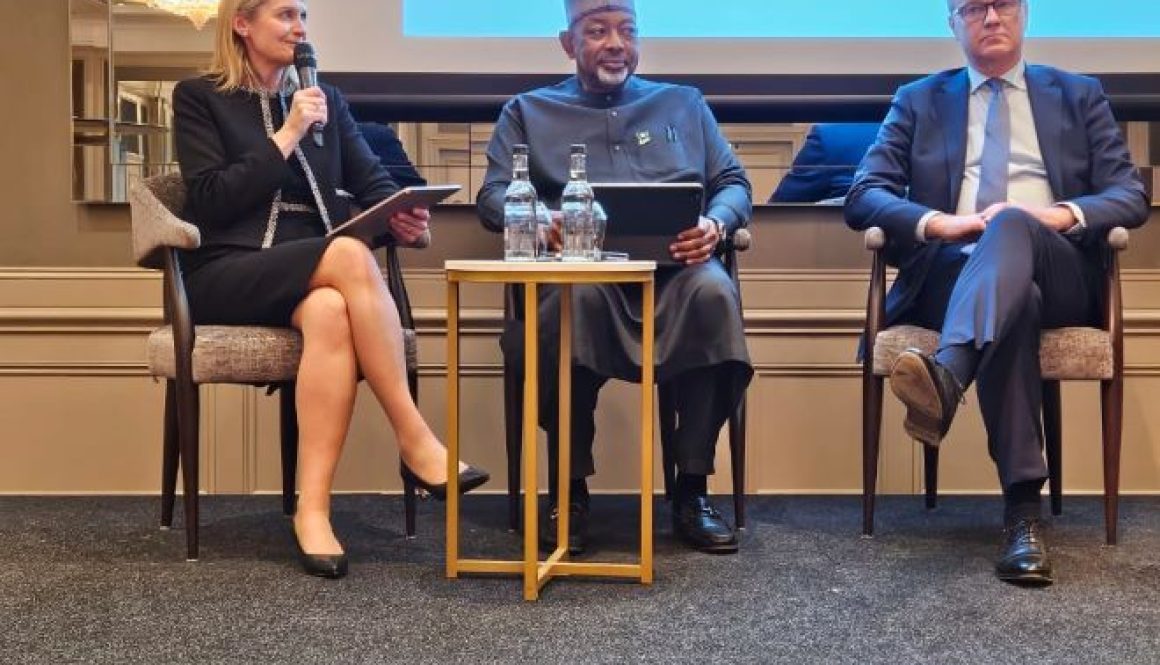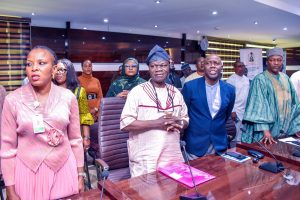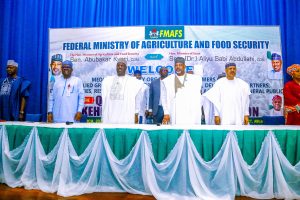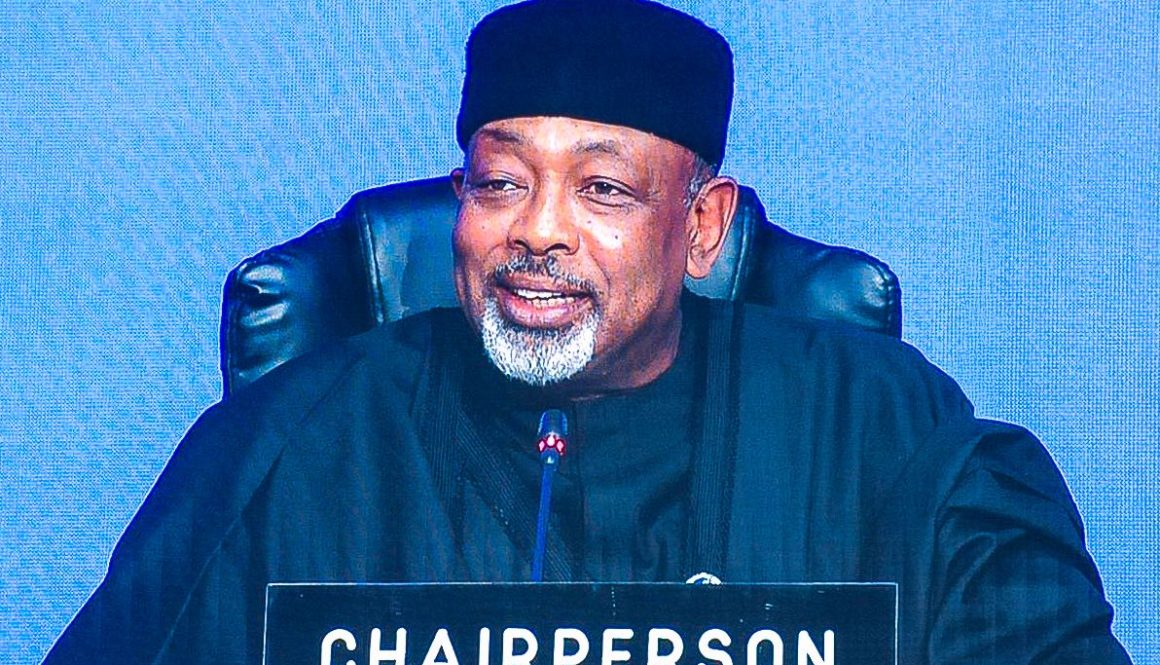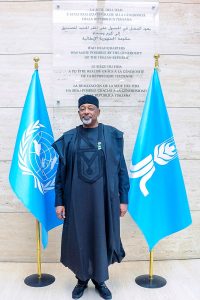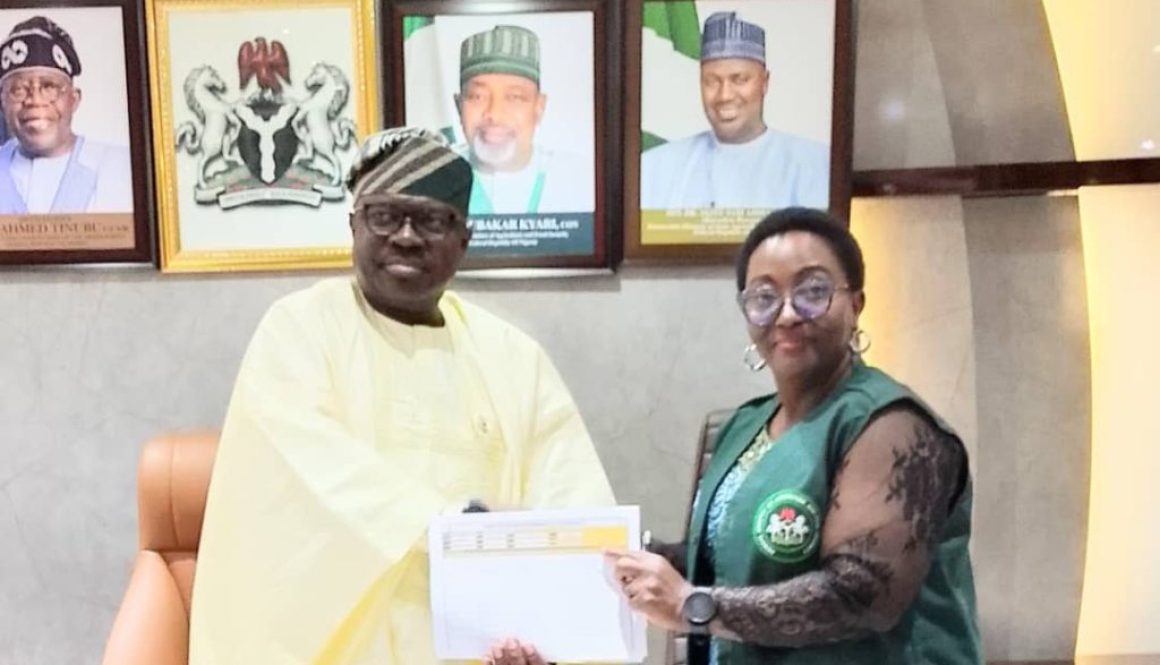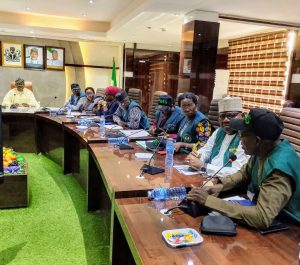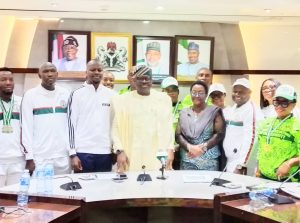
The Minister of State for Agriculture and Food Security, Sen. Dr. Aliyu Sabi Abdullahi has advocated for the recapitalization of the Nigeria Agricultural Insurance Corporation (NAIC) to boost farmer’s livelihood, achieve food sovereignty and ensure finance enabled agrifood systems.
The Minister made this known during a courtesy visit to the Minister of State for Finance, Dr. Doris Uzoka-Anite, at the Ministry of Finance office in Abuja, recently.
Abdullahi stated that it would build the institutional capacity to offer more innovative, technology driven products that restores public trust and attract private sector investment.
He added that by strengthening its capital base, NAIC would expand insurance coverage to more smallholder farmers, mitigate risks associated with climate change and disasters.
The Minister pointed out that there is a need to consider granting an exemption to enable the agency to operate in line with industry standards for insurance firms and maintain the capacity to pay claims as and when due, thereby keeping it in business.
He stressed the need to support the Renewed Hope Cooperative Revamping and Reform Programme in line with the President’s drive for inclusive agricultural ecosystem.
In his words, ‘the revamping programme is designed to review the legal framework, particularly the Nigerian Cooperative Societies Act, and bring it up to date in terms of compliance with the digital economy’’.
He revealed the seven strategic pillars of the revamping programme to include; legal and regulatory reform; digitalization, the establishment of a national cooperative database, cooperative financing and credit access, the establishment of the Cooperative Bank of Nigeria, among others.
In her remarks, the Minister of State for Finance, Dr. Doris Uzoka-Anite, stated that issues relating to food security and economic growth are critical to the Renewed Hope Agenda of Mr. President.
She added that that strengthening NAIC within the evolving regulatory landscape, including the Nigerian Insurance Industry Reform Act, is critical to improving resilience and financial sustainability.
She revealed that ‘’these strategic reforms, underscore Nigeria’s commitment to transforming agriculture into a resilient, market-driven sector, boost food security, and inclusive economic growth’’.
The Minister of State for Agriculture and Food Security, Sen. Dr. Aliyu Sabi Abduallahi has said that strategic partnership would fast track development in the agricultural insurance ecosystem through alignment of policies, reforms, inclusivity and enabling environment for economic opportunities and productivity.
The Minister made this disclosure during the courtesy visit by the National Insurance Commission (NAICOM) delegation led by the chief executive officer, Mr. Olusegun Omosehin, held in Abuja, recently.
Abduallahi stated that the collaboration aims to accelerate reforms, particularly by leveraging the Nigerian Insurance Industry Reform Act (NIIRA) 2025 to modernize the sector and provide an enabling environment for economic opportunities and productivity in agricultural sector.
He added that the partnership would facilitate data-driven solutions through the Ministry’s Data Analytics to support index insurance and enhance food security.
He said insurance for cooperative societies was essential, in line with global best practices, this must be done without losing the cooperative identity regarding its value in terms of integrity, governance among others.
The Minister pointed out that “Studies have shown that most of the countries that have stable economy performance actually have very viable cooperatives’’.
He revealed that “the Renewal Hope Agenda of President Tinubu is clear- to improve governance, every sector should harmonize policies’’.
He stated that the meeting was a milestone event and it would strengthen collaboration with the commission.
According to him ‘’ the ministry required a strong technical working relationship with NAICOM to transform the food system, we are looking at having a Memorandum of Understanding between the Ministry and NAICON regarding Nigerian Agricultural Insurance Corporation (NAIC) and cooperative reform’’.
In his remarks, NAICOM, Chief Executive Officer, Mr. Olusegun Omosehin, stated that the initiative aligned with the administration’s agenda on peace, security and economic stability.
He pointed out that NAIC, is the country’s specialized agricultural insurer and under the ministry’s purview.
According to him, ‘’NAIC plays a fundamental role in protecting smallholder farmers and strengthening food security resilience.
He stressed that “the visit is basically to reveal our partnership to align policies in the agricultural space, such that we can jointly elevate NAIC to a level that it can deliver on its mandate.
The Minister of State for Agriculture and Food Security, Sen. Dr. Aliyu Sabi Abdullahi has pledged that the ministry would support agricultural and infrastructure development at the Federal University of Education, Kontagora, (FUEK) in Niger State, and other Tertiary institutions in the country towards achieving food security, poverty reduction, and economic growth.
The Minister of State for Agriculture and Food Security, Sen. Aliyu Sabi Abdullahi made this declaration during a courtesy visit by the university’s delegation led by the Vice-Chancellor, Prof. Faruk Haruna, at the National Agricultural Growth Scheme-Agro – Pocket (NAGS – AP) office in Abuja, recently.
Sen. Dr. Aliyu Abdullahi stated that Agricultural development support and collaboration with the Federal University of Education would focus on practical, hands-on experience and entrepreneurship that is profitable for students, as well as foster a new generation of Agripreneurs.
He advised that the institution should focus on “Smart agriculture business which uses digital technology, data analytics to boost efficiency, profitability, and sustainability, moving beyond traditional farming to optimize inputs and improve yields through precision management, creating a data-driven, connected food system from farm to production”.
He revealed that “Agriculture teachers used to be the best then but gradually dying off which led to the formation of Young Farmers Club (YFC), a youth organization focused on engaging young people in agriculture through practical skills, modern techniques, and leadership, aimed at making farming appealing, promote food security, and foster self-reliance, with major initiatives recently launched in Nigeria by the First Lady to boost youth involvement in farming as a viable career”.
In his remarks, the Vice Chancellor, Federal University of Education, Kotangora, Prof. Faruk Haruna, revealed that the Minister sponsored the bill establishing the university while serving as senator for Niger North, and it was assented to by former President Muhammadu Buhari on Dec. 31, 2021.
He requested the establishment of agro-processing, value addition centers for training and research, as well as support for modern farm machinery, renewable energy, cold rooms, greenhouses, and irrigation facilities.
The Federal Ministry of Agriculture and Food Security has signed a Memorandum of Understanding (MOU) with the International Institute of Tropical Agriculture (IITA) to enhance soil health, improve fertilizer efficiency, and transform the agricultural ecosystem.
Speaking during the Signing of MOU Ceremony at the Ministry’s Conference Room in Abuja, recently, the Minister of Agriculture and Food Security, Sen. Abubakar Kyari said that the initiative is part of a broader strategy to transform soil management practices, increase agricultural productivity, and ultimately achieve food sovereignty for the nation, and also part of the presidential soil health scheme.
Sen. Abubakar Kyari stated that the Agreement would provide farmers with data driven recommendations for fertilizer use and crop selection, which can help optimize yields and reduce costs.
He added that the collaboration would also focus on enhancing land management and climate services, developing national expertise, and establishing a model for regional cooperation.
The Minister stressed that both parties would work together to tackle issues such as soil nutrient depletion, erosion, and climate change effects using advanced technologies.
He pointed out, “Beyond food availability and affordability, the government was committed to ensuring nutritional quality and safety. If the soil is not healthy, no matter the effort, the desired results cannot be achieved”.
In his remarks, the Minister of State for Agriculture and Food Security, Sen. Dr. Aliyu Sabi Abdullahi said that “the purpose of this Memorandum of Understanding (MoU) is to articulate the understanding and willingness of the Parties (the ministry and IITA) to evaluate the benefits of their collaboration, facilitating any joint preliminary study and due diligence related to the proposed partnership, while also delineating the general intentions of the Parties regarding such collaboration. This MoU does not impose any legal obligations on either Party concerning the proposed collaboration”.
He noted that ‘’ this MoU is anchored on three fundamental objectives, which are Strengthen Agricultural Land Management and Climate Change Services with emphasis on Soil Health and Fertilizer Management in Nigeria, Build National Capacity through applied research, soil fertility practice management data systems, and policy support and Promote a model of collaboration that can inspire and inform similar efforts across the ECOWAS region.
According to him, “This scheme is designed to remove guesswork for Nigerian farmers by giving them facts, what to plant, where to plant, and the type of fertilizer required for each soil type”.
He explained that laboratories would be sited across 774 local government areas, which will enable farmers to submit soil samples for analysis and receive recommendations similar to medical laboratory tests.
Dr. Aliyu Abdullahi revealed that “since the inauguration of Mr. President Asiwaju Bola Ahmed Tinubu GCFR, he has made agriculture a top priority in Nigeria through the Renewed Hope for Food Security and Sovereignty initiative”.
“This commitment goes beyond mere political rhetoric; it is a serious mandate that Mr. President has embraced with full dedication, including mobilizing both local and international support to ensure food availability for all citizens in the nation”, he added.
He lauded the IITA for its strong collaboration and multi-faceted partnership with Nigeria over the years, focusing on transforming our agriculture for food security and economic growth through research, innovation, capacity building and technology transfer targeting climate resilience, data-driven farming and youth/women empowerment.
During his welcome address, the Director – General, International Institute of Tropical Agriculture (IITA), Dr Simeon Ehui, said that the agreement would support the Nigeria Farmers’ Soil Health Scheme (NFSHS) and the continued development of the Nigerian National Soil Information System (NNSIS)
Dr. Ehui stated that the partnership as a policy and delivery commitment is designed to provide farmers with data-driven, location-specific recommendations rather than “generalized messages”.
He revealed that implementation would be channelled through the Regional Hub of Fertilizer and Soil Health for West Africa and the Sahel, hosted by IITA, to ensure coordination, common standards, and shared learning across countries.
“This approach assures a standards-based system rather than isolated interventions, while allowing Nigeria to benefit from regional expertise,”
He emphasized that the initiative would deliver crop and location-specific fertilizer recommendations for key staples such as rice, maize, sorghum, wheat and yam alongside integrated soil fertility management, improved laboratory standards, digital soil information systems and capacity building.
He stated that IITA would provide research and technical expertise, training, soil testing support, and monitoring frameworks to ensure measurable outcomes.
“The real test of this MoU will be results-improved soil health systems, higher fertilizer use efficiency, stronger national capacity and accelerated progress towards food security,” he added.
The highlight of the event was the signing of MoU by the officials of the ministry and IITA.
The Minister of Agriculture and Food Security, Sen. Abubakar Kyar has tasked the Combined National Project Steering Committee to deliver its mandate, stating that it would transform the agricultural ecosystem and achieve food security, economic diversification, and inclusive prosperity.
The Minister made this known during the Combined National Project Steering Committee (NPSC) meeting held at the Ministry’s Conference Room in Abuja on Thursday, 18th December, 2025.
Kyari stated that ‘’It is a strategic committee that sits at the intersection of policy authority, development financing, and the national imperative to secure the future of nation’s food systems’’
He emphasized that ‘’ It is important to state that this committee is not ceremonial. It is a governing body that shapes the direction, credibility, and impact of the Federal Government of Nigeria (FGN) and Development Partners supported agricultural programmes in Nigeria’’.
He revealed that ‘’ the Ministry has resolved to exercise its oversight mandate with renewed firmness, zero tolerance for inefficiency, and uncompromising accountability. The era of business-as-usual is over, Under the Renewed Hope Agenda, programmes must be aligned, performance must be measurable, and outcomes must be visible to the Nigerian people’’.
The Minister added that ‘’ the approvals we give, the standards we enforce, and the discipline we demand will determine whether public resources translate into national transformation or remain trapped in paperwork and process’’.
He further revealed that ‘’ In line with this direction, I am pleased to announce that the Ministry has taken a decisive institutional step to elevate the authority and effectiveness of the Projects Coordinating Unit (PCU) to a full-fledged department of Development Partnership Projects.
According to him, ‘’This is not a cosmetic adjustment, it is a deliberate restructuring to strengthen supervision, tighten coordination, enforce standards, and entrench results-based management across all development partners–supported programmes. The message is simple: projects must perform, or they will be restructured’’.
He noted that ‘’as we examine the 2026 Annual Workplans and Budgets (AWPB), it is important to state that this Committee will no longer treat AWPB approvals as routine formal Every proposal before us must demonstrate clear alignment with national priorities, food security, productivity enhancement, value chain development, youth engagement, and inclusive economic growth.
‘’These are not optional goals; they are the core pillars of the Renewed Hope Agenda. Budgets must speak to impact, not intentions. Activities must deliver value, not volume’’, the Minister added.
He stressed that ‘’ we will strengthen the practice of Government-led pre-missions, involving relevant technical teams, to support projects teams ahead of main supervision missions.
‘’These pre-missions will enable early identification of gaps, facilitate timely corrective actions, and ensure that supervision missions are more strategic, solution-oriented and aligned with government priorities that will reach the final beneficiaries’’.
He said that ‘’development partners–supported programmes, guided by this Committee, remain critical instruments for achieving the objectives of the Renewed Hope Agenda’’.
The Minister reiterated the commitment of the Federal Government, under the leadership of His Excellency, President Bola Ahmed Tinubu, GCFR, to transforming the agricultural sector as a key driver of food security, economic diversification and inclusive prosperity.
In his welcome address, the Permanent Secretary, Dr. Marcus Ogunbiyi said that “the committee is the apex oversight and governance platform for development partners–supported projects under the Ministry”.
Ogunbiyi appreciated the minister for his leadership and strategic direction in steering the ministry’s engagement in line with Renewed Hope Agenda in advancing national food security, agricultural productivity, and rural transformation, among others.
The Minister of Agriculture and Food Security, Sen Abubakar Kyari, has launched the Electronic Document Management System (EDMS) to boost effective service delivery, strengthen transparency, preserve institutional memory, and improve workflow efficiency.
Speaking at the launch of the GO LIVE EDMS at the Ministry’s Conference Room on Thursday 18th December 2025 in Abuja, Sen. Abubakar Kyari stated that the EDMS was developed under the broader Federal Civil Service Strategy and Implementation Plan 2021–2025 (FCSSIP 25) and designed to digitize records, automate workflows, and drastically reduce reliance on paper-based processes.
He pointed out that the system was part of the federal government’s goal to achieve 80% digitalization of government operations by the end of 2025 and a fully paperless civil service by 2030.
Kyari added that the initiative would fundamentally transform how records are created, processed, stored, accessed, and secured within the Ministry
The Minster emphasized that it would also significantly reduce reliance on paper-based processes, and eliminate delays associated with manual file movement, enhance collaboration across departments, improve document traceability, as well as strengthen audit and security controls. “These improvements are critical to informed decision-making, policy continuity, and effective governance”.
He revealed that “a Ministry as strategic as Agriculture and Food Security — one that plays a central role in livelihoods, economic diversification, and national stability — efficiency and responsiveness are non-negotiable The EDMS will therefore serve as an enabler, ensuring that information flows seamlessly, decisions are timely, and institutional knowledge is preserved for continuity and future planning”.
He urged ‘’all staff of the Ministry to fully embrace this system and integrate it into their daily operations. The success of the EDMS will not be measured solely by its technical capabilities, but by our collective discipline in usage, adherence to established workflows, and continuous capacity building’’.
He lauded ‘’the Permanent Secretary, the Department of Planning & Policy Coordination, the Project Implementation Team, and all Directors and staff who contributed to the successful deployment of this solution. Change is often challenging, but your cooperation and openness demonstrate a shared understanding that a modern public service must be agile, technology-driven, and results-oriented’’.
The Minister appreciated ‘’the implementation consultants, Quomodo Systems, for their professionalism, technical competence, and unwavering commitment throughout this project. Their collaborative engagement and understanding of public sector processes were instrumental in delivering DOC STREAM, a robust, secure, and user-centric EDMS solution tailored to the operational realities of FMAFS and aligned with our digital transformation objectives’’.
In his remarks, the Minister of State for Agriculture and Food Security, Sen. Dr. Aliyu Sabi Abdullahi said that ‘’ the EDMS will fundamentally change the way we create, manage, store, retrieve, and secure official records. It will reduce our dependence on paper-based processes, minimize delays in file movement, improve collaboration across departments, and strengthen records security and audit trails. Ultimately, this system will support faster decision-making and more effective governance within the Ministry’’.
In her Goodwill Message, the Head of the Civil Service of the Federation, Mrs. Didi Esther Walson – Jack said that ‘’the Federal Ministry of Agriculture and Food Security occupies a pivotal position in Nigeria’s development architecture. Its mandate touches food security, agricultural productivity, value-chain development, rural livelihoods, and national nutrition outcomes.
She added that ‘’ it is therefore both timely and commendable that the Ministry is embracing a modern, secure, and efficient approach to managing its records and information, recognizing that sound policies and programmes must be supported by reliable data and effective systems’’.
During his welcome address, the Permanent Secretary, Dr. Marcus Ogunbiyi stated that ‘’ event marks a significant milestone in our Ministry’s journey towards digital transformation, operational efficiency, and improved service delivery’’.
Dr. Ogunbiyi appreciated’’ the cooperation of the Directors and staff who have embraced this change, understanding that digital transformation is essential to building a modern, agile, and results-oriented public service’’.
The Minister of Agriculture and Food Security, Sen. Abubakar Kyari has said that internal appraisal and refocusing of sectoral initiatives would accelerate growth in the agriculture sector, stating that a proactive and adaptive management approach, policy reform, and strategic planning will drive sustainable agricultural development and enhance food sovereignty
The Minister made this disclosure during the Ministerial Sectoral Retreat with the theme ‘’Performance Improvement and Strategic Alignment’’ held at African Trade Centre, Onomo Allure, Abuja on Tuesday, 16th December, 2025 in Abuja.
Kyari stated that the Federal Government has intensified its efforts to reposition agriculture as a major driver of economic growth, job creation, and investment, with a new policy focus on mechanization, value-chain development, agribusiness financing, and market expansion, among others.
He pointed out that “Ministry is committed to leveraging technology, Innovation, and climate-smart agriculture to boost productivity and resilience. Let us commit to the mission of feeding Nigeria, creating jobs, and driving economic growth through sustainable agriculture”.
The Minister revealed that ‘’ the Ministry is working with several international partners to secure funding and expertise to support our agricultural initiatives. Specifically, the Federal Government’s commitment is to ensure farmers’ safety, manage agricultural landscape, provide rural infrastructure, intensify research innovation, facilitate extension services, and undertake agribusiness ventures across the country’’.
He reaffirmed that ‘’the policy direction is aimed at unlocking agriculture’s full business potential by transforming farming into a scalable, profitable enterprise “Our focus is to transit from subsistence to commercial farming. Agriculture must deliver productivity, income, jobs, and wealth creation’’
Kyari further revealed that ‘’the Federal Government is implementing mechanization partnerships with international equipment manufacturers from Belarus, Brazil, and global firms such as John Deere and Origin, in a bid to close Nigeria’s long-standing tractorisation gap’’.
He added that the initiative would reduce production costs, increase yields, and attract private investment into farming and agro-processing.
He mentioned that the ministry is expanding Public-Private Partnerships (PPPs) through the establishment of Special Agro-Industrial Processing Zones, Agro-Industrial Estates, Agro-Processing Centers and Cottage Processing Mills, these facilities are designed to boost value addition, reduce post-harvest losses and deepen agro-industrial activities nationwide’’.
He noted that ‘’to improve market stability and reduce price volatility, the ministry is implementing a National Food Reserve Programme to mop up excess production during peak seasons, ensuring a steady supply and predictable pricing for both farmers and consumers’’.
Other market-oriented initiatives include the development of Commodity Market Hubs, Farmers’ Markets, and Rural and Cooperative Markets to expand consumer demand and improve farmers’ access to profitable outlets, he added.
He stressed that the ministry has programmes targeting youth and women in agribusiness, describing them as key to unlocking Nigeria’s demographic dividend and stimulating rural economies.
In his remarks, the Minister of State for Agriculture and Food Security, Sen. Dr. Aliyu Sabi Abdullahi said the ministry is deliberately restructuring itself to support private sector participation, data-driven decision-making, and performance management.
He revealed that new departments have been created, namely Agricultural Mechanization, Agricultural Data and Analytics, Agricultural ICT, Horticulture, Plant Health, and Development Partners Projects, to sharpen the ministry’s focus and improve efficiency.
He pointed out that ‘’the ministry is strengthening financing windows through the Bank of Agriculture and the National Agricultural Development Fund to support farmers, processors and agribusiness investors across the value chain’’.
In her Goodwill message, the Head of the Civil Service of the Federation, Mrs. Didi Esther Walson-Jack, represented by the Senior Special Assistant to the President on Civil Service Matters, Mr. Alfred Abba said that the retreat would deepen leadership cohesion, reinforce institutional discipline, and chart a clear, unified pathway for ministry and its agencies in line with reforms policies in the public services.
During his welcome address, the Permanent Secretary, Dr. Marcus Ogunbiyi stated that ‘’ the Retreat provides us with a valuable opportunity to pause, reflect, and strategically reposition the ministry and its agencies for greater effectiveness in the discharge of our mandate’’
He revealed the key institutional milestone that forms an important focus of the retreat ‘’the validation of the performance management systems (PMS) Automation and the electronic content management (ECM) Platform, in preparation for the Go live of the ECM Platform on 18th December,2025.
Dr. Ogunbiyi added that ‘’ the Go live was planned to be after this retreat where all of us will have the opportunity to jointly do the validation exercise for the two platforms. This exercise is both strategic and transformational for the ministry’’.
The Minister of Agriculture and Food Security, Sen. Abubakar Kyari has said that the scaling up of youth agripreneurship is inevitable in agri food systems transformation stating that innovation, technology, funding support and entrepreneurship are critical for Food Security, Economic Growth, and Resilient Agricultural Ecosystem.
The Minister made this announcement during the High-Level Event on Scaling Up Youth Agripreneurship in Nigeria for Food Systems Transformation through the FGN/NDDC/IFAD Livelihood Improvement Family Enterprises Niger Delta (LIFE-ND) Project, held in Abuja on Tuesday, 9th December 2025.
Kyari stated that young agripreneurs, fuelled by ingenuity and determination, are taking the lead in agrifood innovation, from precision agriculture to AI-powered farm tools, soilless farming, financing and payment platforms, digital marketplaces, and agro-processing.
He pointed out that ‘’they are leading with innovation and a shared commitment to sustainable development and are ready to transform agrifood systems, create dignified livelihoods and drive inclusive economic growth in our dear Nation, Nigeria’’.
The Minister stated that ‘’ through strategic investments and strengthened partnerships with civil society, the private sector and development partners, we have already demonstrated proof of concept’’.
‘’We have piloted youth-led agripreneurship models, expanded agro-processing and agribusiness incubation and leveraged digital tools to connect farmers to markets and finance, showing what is achievable when policy aligns with purpose’’, he added.
He highlighted measures to scale up youth agripreneurship across the country, including unlocking land and productive resources for young farmers, expanding access to inclusive finance, credit guarantees, and accelerating business development support – mentorship as well as strengthening market systems through digital platforms, among others.
The Minister emphasized the need to strengthen the following support pillars: A land access and tenure assistance program that prioritizes youth eligibility and transparent processes, An innovative fund/financing mechanism with blended finance options and simplified access for youth-led agribusinesses, including maximum timelines for decision making, An expanded set of business development services, including mentorship networks, virtual incubation, and market linkages, with measurable success metrics, A digital platform for youth agripreneurs to showcase products, access buyers, and receive real-time market intelligence,
‘’A practical and proactive climate adaptation and risk management framework integrated into all youth-led programs, with training on sustainable farming, post-harvest handling, and value-added processes and A robust monitoring, evaluation, and learning (MEL) system that tracks progress by age, gender, region, and value chain, and shares lessons learned publicly’’.
He revealed that “the FGN/NDDC/IFAD assisted Livelihood Improvement Family Enterprises in the Niger Delta is a testament and strong evidence that showcases this concept and strategy”.
The Minister called on “all actors—government ministries and agencies, financial institutions, development partners, the private sector, academia, farmers’ organizations, and, most importantly, young agripreneurs— to join hands”.
He appealed to stakeholders ‘’ Let us align our incentives so that risk-taking is rewarded and success is shared. Let us build ecosystems where collaboration eclipses competition and where every young agripreneur has a fair chance to contribute to our national prosperity’’.
The Minster thanked ‘’development partners, the private sector, and the countless champions who have already helped us on this journey. Your trust and collaboration give us confidence that scaling-up youth agripreneurship is not only possible but inevitable’’.
In his welcome remarks, the Permanent Secretary, Dr. Marcus Ogunbiyi stated that ‘’ objective of this event aligns with the Federal Government’s strategic goal of repositioning agriculture as a viable, wealth-creating, and competitive sector–one capable of reducing unemployment, deepening value addition, and contributing significantly to national prosperity’’
Dr. Ogunbiyi added that ‘’We envision an agricultural landscape where young agripreneurs emerge not merely as participants, but as innovators, employers, and industry leaders across processing, logistics, technology, and value chain development’’
He pointed out that ‘’LIFE-ND is essentially and truly unique with its incubation model which nurtures young agripreneurs through Skills development and hands-on vocational training, Structured mentorship by established agribusinesses
Access to digital tools and modern technologies, market linkages, and value chain integration’’
During his vote of thanks, the National Project Coordinator, Livelihood Improvement Family Enterprises – Niger Delta, Dr. Abiodun Sanni said that ‘’ The LIFE-ND Project has demonstrated that with the right model, Nigeria can convert its youthful population from job seekers to agripreneurial wealth creators capable of transforming the nation’s food system.
He added that ‘’ we are confident that with sustained commitment, expanded partnerships, and the scaling strategies presented, LIFE-ND will evolve into a national model for agricultural prosperity, food security, and economic resilience’’.
He revealed that through LIFE-ND Project ‘’ over 23,751 direct jobs within rural communities, increased household incomes by an average of 50% among beneficiaries, contributing to poverty reduction and community resilience’’.
The Minister of Agriculture and Food Security, Sen. Abubakar Kyari, has stated that private sector participation in the agricultural ecosystem will drive investment, innovation, and inclusive growth.
The Minister made this known during a courtesy visit by the Food and Agriculture Organization (FAO) delegation, led by Alessandro Marini, FAO Chief for the Investment Centre in West and Central Africa, held at the Ministry’s Conference Room in Abuja recently.
Kyari stated that the federal government would provide an enabling environment by establishing clear-cut policies, regulatory frameworks, and an overall stable business climate that incentivizes private investment and mitigates risk.
He stated that ‘’ during previous meetings, we presented some key partners and highlighted shared belief that the private sector is the primary engine of growth. You agreed that the focus of the European Bank for Reconstruction and Development (EBRD) investment should be on strengthening private sector participation’’.
He added that ‘’ this meeting will provide an opportunity for you to hear directly from directors of departments and technical teams, as well as private sector partners, so that you can gain a deeper understanding of the opportunities across value chains. We also have with us the Executive Secretary of the National Agricultural Development Fund, a three-year-old institution designed to support agricultural financing and innovation’’.
He stressed that ‘’we discussed several priority areas for investment and explored potential partnerships that can deliver measurable impact. As a government, we stand fully ready to support your next steps and work with you to advance shared objectives’’.
He pointed out that ‘’We are encouraged that the FAO Investment Centre, working in partnership with EBRD, has also expanded its footprint by opening an office in Lagos earlier this year’’.
The Minister advised that ‘’ it would have been even more insightful for you to visit some of production sites across the country, where you can see firsthand the scale and diversity of agricultural activity, from staple crops to livestock and more.
He revealed that ‘’ the visit also aligns strongly with the directive given to us by the President, who has mandated that we take full responsibility for strengthening Nigeria’s food systems and building a pathway towards food sovereignty.
He noted that ‘’Nigeria remains one of the most promising agricultural markets, with immense potential supported by a young, rapidly growing population. We are currently around 232 million people, and the World Bank projects that we will reach 400 million by 2050. That is only 25 years from now, a period that will pass quickly, just as the year 2000 feels like yesterday, the urgency is clear’’.
In his remarks, the FAO Chief for the Investment Centre in West and Central Africa, Alessandro Marini, stated that organization would work assiduously with the federal government to unlock Nigeria’s agribusiness investment in line with government’s economic diversification policy.